
Hi, I’m Michelle Kambasha, Brand and Digital Communications Officer at Creative Arts Social. What We’re Engaging With is where the CAS team shares the thinking and materials behind our work. We began with food: High on the Hog and the land and labour behind what reaches our plates. I then turned to visual culture with Kwame Brathwaite and Black Is Beautiful, asking who gets to be looked at. This third post turns to public history, and to the question running through all three: who gets to belong?
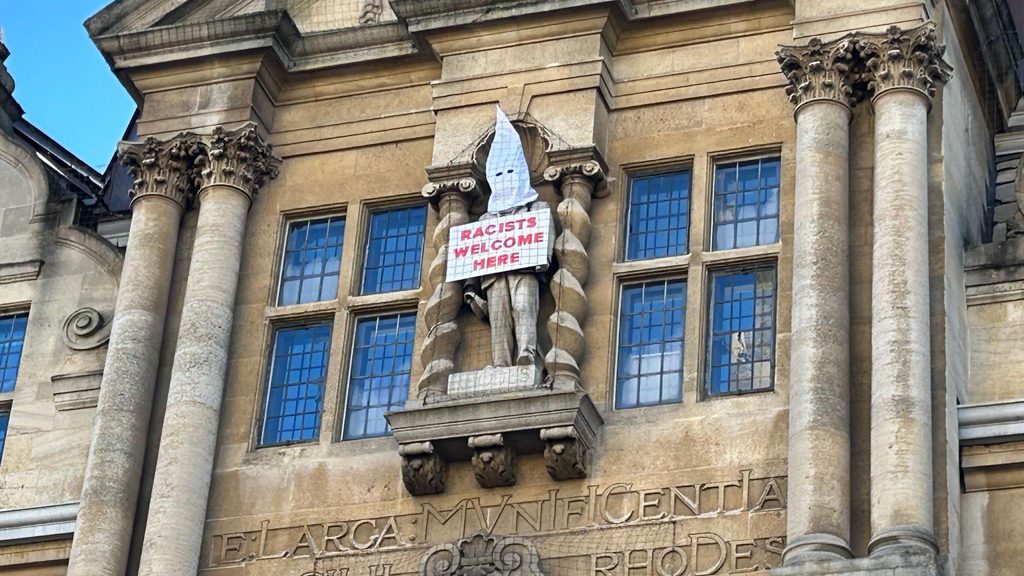
Last Thursday, Oxford woke up to Cecil Rhodes wearing a Ku Klux Klan hood. The campaign group Led By Donkeys had hung a sign beneath his statue at Oriel College: “Racists Welcome Here.” They were protesting the college’s decision to host Nathan Cofnas, a self-described “race realist”, for a talk asking whether diversity, equity and inclusion is undermining higher education. Cofnas is also the academic who led the plagiarism accusations against Professor Jason Arday, Cambridge’s youngest Black professor, who died in August. We wrote about what that debate revealed about race and legitimacy in Beyond the headlines. The hood was gone by the afternoon. The statue stayed.
On Tuesday night, the talk went ahead. A petition against it had passed 32,000 signatures, and Oriel’s own student and staff common rooms had condemned Cofnas’s views, but the college said the Higher Education (Freedom of Speech) Act 2023 left it no choice. Hundreds of people filled the High Street, Oriel Square and Merton Street, bringing traffic to a standstill. Protesters blocked the lecture theatre’s entrances, and the college spent the evening in effective lockdown. Cofnas spoke to around 25 people and left under police protection. Thames Valley Police are investigating two reported assaults, one of them on an officer.
For me, Rhodes isn’t an abstraction. I’m Zimbabwean. I was born in a country that once carried his name, and I moved to the UK when I was four. My parents lived through the war of independence that ended in 1980. For them, Rhodesia wasn’t a name in a history book; it was a lived reality. Now I live in a place where Rhodes’s name still sits on a scholarship, a building and a statue above one of its most famous streets. So I didn’t come to this neutrally, and I’m not sure anyone with roots in southern Africa can.
At CAS, we describe belonging as being seen, heard, valued and understood without having to change who you are. Public monuments are one of the clearest ways an institution tells people whether that’s true. For anyone unfamiliar with him, Rhodes made his fortune in diamonds and gold, and his British South Africa Company used armed force to take the land that became Rhodesia, now Zimbabwe and Zambia, at a devastating cost in lives and homes. As Prime Minister of the Cape Colony, his Glen Grey Act imposed a labour tax that pushed African men into work on white-owned farms and mines. Rhodes’s will gave Oriel £100,000, but it never asked for a statue. The college chose to put one in “the most conspicuous place in Oxford”, above two kings and four of its own heads. The historian Pierre Nora would call it a dominant lieu de mémoire, a site of memory imposed from above.
What it leaves out matters just as much. As with the food in High on the Hog, the story stops short of the people whose land and labour built the wealth. Simukai Chigudu, a Zimbabwean-born founder of Rhodes Must Fall Oxford, described walking beneath such monuments as being surrounded “not by the ghosts of colonialism, but by its living dead”. Brathwaite’s photographs were about being seen on your own terms. This statue asks Black students to look up, every day, at a monument that doesn’t see them at all.
In June 2020, two days after Black Lives Matter protesters pulled down the statue of the slave trader Edward Colston in Bristol, thousands gathered beneath Rhodes in Oxford. Within weeks, Oriel voted that it wanted the statue removed, and an independent commission agreed. A year later the college backed away, citing cost, listed-building rules and the government’s policy of retain and explain, and added a small plaque. Money mattered too. In 2016, leaked documents showed that donors had threatened to withdraw gifts and bequests worth more than £100 million if the statue came down, and that £1.5 million had already been cancelled. Oriel denied that money played a part. Part of what holds Rhodes there is the scholarship that carries his name, which ties it to excellence and makes removal costly. It’s a pattern we recognise across the sector: a visible gesture standing in for structural change. As the philosopher Zofia Stemplowska puts it, “Even ‘contextualised’, it elevates him.” This week followed the same pattern, with the college again saying the rules left it no choice.
Yet the statue’s meaning has shifted, and it has shifted from below: through Rhodes Must Fall, Redress Rhodes, an inscription at Rhodes House in ǀXam, Zimbabwean sculpture shown at Oriel last year, and now a hood, a banner and a crowd on the High Street. The historian Raphael Samuel wrote that history is made by “a thousand different hands”. That’s how we think about heritage at CAS: something communities make together, not something handed down.
We often say that belonging is not simply opening a door, but changing the conditions inside it. This week Oriel’s doors were blocked, guarded and locked down, but the conditions inside haven’t changed, and neither has the man standing highest above the High Street. Across these three posts the questions have been the same: who gets fed, who gets seen and who gets remembered. For every museum, gallery and heritage organisation we work with, they come down to one: what is your building telling people about who belongs?
That brings What We’re Engaging With full circle. A meal, a photograph and a statue might seem worlds apart, but each one carries a story about who belongs. High on the Hog showed how food holds the memory of land and labour that history tried to erase. Brathwaite’s photographs showed what changes when people are pictured on their own terms. And Oriel shows what happens when an institution decides whose story stands highest, and keeps on deciding it, while insisting it has no power to decide at all. At CAS, we see belonging as both a personal experience and a collective practice. It is built, or withheld, through everyday choices about what we eat, what we look at and what we choose to remember. Thank you for reading along with us. We’d love to hear what you’ve been engaging with too.
Further listening: Legacy, Afua Hirsch and Peter Frankopan’s history podcast, has a three-part series on Cecil Rhodes. It follows him from a vicar’s son joining the diamond rush in Africa, through the tactics he used to take land from the people living there, to the fallout from the Jameson Raid. It’s a good companion to this piece if you want the fuller story of the man on the High Street.
Further reading: Zofia Stemplowska’s The Rhodes Statue: honour, shame and responsibility.
Sources and further reading
- Cherwell: KKK hood and sign on Cecil Rhodes statue removed after activist group’s ‘makeover’ (12 November 2026)
- Cherwell: Oriel Provost and Proctors confirm that Cofnas event will go ahead (11 November 2026)
- Cherwell: Forty-nine Oriel SCR members condemn Nathan Cofnas’ views in statement (10 November 2026)
- Stemplowska, Z. (2021) The Rhodes Statue: honour, shame and responsibility
- Ahmed, A.K. (2020) #RhodesMustFall: How a Decolonial Student Movement in the Global South Inspired Epistemic Disobedience at the University of Oxford
- Oriel College (2021) Decisions following the Independent Commission
- Rhodes Trust: Legacy, Equity and Inclusion
- Contested Histories: Rhodes Statue at Oxford
- CAS: High on the Hog: Food, Land and Belonging
- CAS: Kwame Brathwaite: Black Is Beautiful. Who Gets To Be Looked At?
- Officer ‘assaulted’ during protest against academic who made Arday claims (18 November 2026)
- Oxford Mail via Yahoo: Police attend as hundreds protest Nathan Cofnas Oxford University college talk (17 November 2026)
- Cherwell: Protests start outside Oriel College ahead of Nathan Cofnas event (17 November 2026)