Creative Arts Social (CAS) Consultancy - Creative Arts Social (CAS) Consultancy
  • Home
  • About Us
    • History
    • What We Do
    • Why we Do it
    • Who We Are
    • Meet the Team
    • Press
  • Services
    • Cultural Strategy
    • Evaluation
    • Programme Design
    • Research 
    • Digital Archives
    • Coaching & Mentoring
    • Key Notes, Lectures & Facilitation
  • Clients
    • Client Testimonials
  • Our Research
    • The Belonging Project
    • Belonging: Our Definition
    • Belonging Notes
  • Blog
    • Notes From the Sector
    • CAS Recommends
    • What We’re Engaging With
    • CAS Reflections
    • Interviews
    • Gallery
      • Arts Engagement
      • Events
      • Inspiration
  • Contact
Home
About Us
    History
    What We Do
    Why we Do it
    Who We Are
    Meet the Team
    Press
Services
    Cultural Strategy
    Evaluation
    Programme Design
    Research 
    Digital Archives
    Coaching & Mentoring
    Key Notes, Lectures & Facilitation
Clients
    Client Testimonials
Our Research
    The Belonging Project
    Belonging: Our Definition
    Belonging Notes
Blog
    Notes From the Sector
    CAS Recommends
    What We're Engaging With
    CAS Reflections
    Interviews
    Gallery
    Arts Engagement
    Events
    Inspiration
Contact
Creative Arts Social (CAS) Consultancy - Creative Arts Social (CAS) Consultancy
  • Home
  • About Us
    • History
    • What We Do
    • Why we Do it
    • Who We Are
    • Meet the Team
    • Press
  • Services
    • Cultural Strategy
    • Evaluation
    • Programme Design
    • Research 
    • Digital Archives
    • Coaching & Mentoring
    • Key Notes, Lectures & Facilitation
  • Clients
    • Client Testimonials
  • Our Research
    • The Belonging Project
    • Belonging: Our Definition
    • Belonging Notes
  • Blog
    • Notes From the Sector
    • CAS Recommends
    • What We’re Engaging With
    • CAS Reflections
    • Interviews
    • Gallery
      • Arts Engagement
      • Events
      • Inspiration
  • Contact
What We're Engaging With

Rhodes Must Fall: Monuments, Memory and Belonging

November 23, 2026 by CASadmin No Comments

Hi, I’m Michelle Kambasha, Brand and Digital Communications Officer at Creative Arts Social. What We’re Engaging With is where the CAS team shares the thinking and materials behind our work. We began with food: High on the Hog and the land and labour behind what reaches our plates.  I then turned to visual culture with Kwame Brathwaite and Black Is Beautiful, asking who gets to be looked at. This third post turns to public history, and to the question running through all three: who gets to belong?

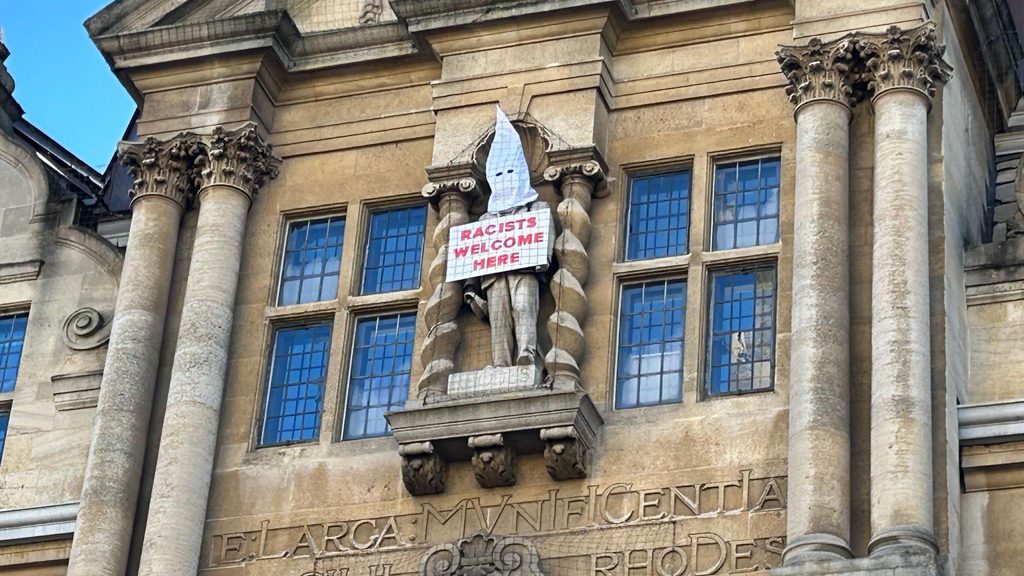
Last Thursday, Oxford woke up to Cecil Rhodes wearing a Ku Klux Klan hood. The campaign group Led By Donkeys had hung a sign beneath his statue at Oriel College: “Racists Welcome Here.” They were protesting the college’s decision to host Nathan Cofnas, a self-described “race realist”, for a talk asking whether diversity, equity and inclusion is undermining higher education. Cofnas is also the academic who led the plagiarism accusations against Professor Jason Arday, Cambridge’s youngest Black professor, who died in August. We wrote about what that debate revealed about race and legitimacy in Beyond the headlines. The hood was gone by the afternoon. The statue stayed.

On Tuesday night, the talk went ahead. A petition against it had passed 32,000 signatures, and Oriel’s own student and staff common rooms had condemned Cofnas’s views, but the college said the Higher Education (Freedom of Speech) Act 2023 left it no choice. Hundreds of people filled the High Street, Oriel Square and Merton Street, bringing traffic to a standstill. Protesters blocked the lecture theatre’s entrances, and the college spent the evening in effective lockdown. Cofnas spoke to around 25 people and left under police protection. Thames Valley Police are investigating two reported assaults, one of them on an officer.

For me, Rhodes isn’t an abstraction. I’m Zimbabwean. I was born in a country that once carried his name, and I moved to the UK when I was four. My parents lived through the war of independence that ended in 1980. For them, Rhodesia wasn’t a name in a history book; it was a lived reality. Now I live in a place where Rhodes’s name still sits on a scholarship, a building and a statue above one of its most famous streets. So I didn’t come to this neutrally, and I’m not sure anyone with roots in southern Africa can.

At CAS, we describe belonging as being seen, heard, valued and understood without having to change who you are. Public monuments are one of the clearest ways an institution tells people whether that’s true. For anyone unfamiliar with him, Rhodes made his fortune in diamonds and gold, and his British South Africa Company used armed force to take the land that became Rhodesia, now Zimbabwe and Zambia, at a devastating cost in lives and homes. As Prime Minister of the Cape Colony, his Glen Grey Act imposed a labour tax that pushed African men into work on white-owned farms and mines. Rhodes’s will gave Oriel £100,000, but it never asked for a statue. The college chose to put one in “the most conspicuous place in Oxford”, above two kings and four of its own heads. The historian Pierre Nora would call it a dominant lieu de mémoire, a site of memory imposed from above.

What it leaves out matters just as much. As with the food in High on the Hog, the story stops short of the people whose land and labour built the wealth. Simukai Chigudu, a Zimbabwean-born founder of Rhodes Must Fall Oxford, described walking beneath such monuments as being surrounded “not by the ghosts of colonialism, but by its living dead”. Brathwaite’s photographs were about being seen on your own terms. This statue asks Black students to look up, every day, at a monument that doesn’t see them at all.

In June 2020, two days after Black Lives Matter protesters pulled down the statue of the slave trader Edward Colston in Bristol, thousands gathered beneath Rhodes in Oxford. Within weeks, Oriel voted that it wanted the statue removed, and an independent commission agreed. A year later the college backed away, citing cost, listed-building rules and the government’s policy of retain and explain, and added a small plaque. Money mattered too. In 2016, leaked documents showed that donors had threatened to withdraw gifts and bequests worth more than £100 million if the statue came down, and that £1.5 million had already been cancelled. Oriel denied that money played a part. Part of what holds Rhodes there is the scholarship that carries his name, which ties it to excellence and makes removal costly. It’s a pattern we recognise across the sector: a visible gesture standing in for structural change. As the philosopher Zofia Stemplowska puts it, “Even ‘contextualised’, it elevates him.” This week followed the same pattern, with the college again saying the rules left it no choice.

Yet the statue’s meaning has shifted, and it has shifted from below: through Rhodes Must Fall, Redress Rhodes, an inscription at Rhodes House in ǀXam, Zimbabwean sculpture shown at Oriel last year, and now a hood, a banner and a crowd on the High Street. The historian Raphael Samuel wrote that history is made by “a thousand different hands”. That’s how we think about heritage at CAS: something communities make together, not something handed down.

We often say that belonging is not simply opening a door, but changing the conditions inside it. This week Oriel’s doors were blocked, guarded and locked down, but the conditions inside haven’t changed, and neither has the man standing highest above the High Street. Across these three posts the questions have been the same: who gets fed, who gets seen and who gets remembered. For every museum, gallery and heritage organisation we work with, they come down to one: what is your building telling people about who belongs?

That brings What We’re Engaging With full circle. A meal, a photograph and a statue might seem worlds apart, but each one carries a story about who belongs. High on the Hog showed how food holds the memory of land and labour that history tried to erase. Brathwaite’s photographs showed what changes when people are pictured on their own terms. And Oriel shows what happens when an institution decides whose story stands highest, and keeps on deciding it, while insisting it has no power to decide at all. At CAS, we see belonging as both a personal experience and a collective practice. It is built, or withheld, through everyday choices about what we eat, what we look at and what we choose to remember. Thank you for reading along with us. We’d love to hear what you’ve been engaging with too.

Further listening: Legacy, Afua Hirsch and Peter Frankopan’s history podcast, has a three-part series on Cecil Rhodes. It follows him from a vicar’s son joining the diamond rush in Africa, through the tactics he used to take land from the people living there, to the fallout from the Jameson Raid. It’s a good companion to this piece if you want the fuller story of the man on the High Street.

Further reading: Zofia Stemplowska’s The Rhodes Statue: honour, shame and responsibility.

Sources and further reading

  • Cherwell: KKK hood and sign on Cecil Rhodes statue removed after activist group’s ‘makeover’ (12 November 2026)
  • Cherwell: Oriel Provost and Proctors confirm that Cofnas event will go ahead (11 November 2026)
  • Cherwell: Forty-nine Oriel SCR members condemn Nathan Cofnas’ views in statement (10 November 2026)
  • Stemplowska, Z. (2021) The Rhodes Statue: honour, shame and responsibility
  • Ahmed, A.K. (2020) #RhodesMustFall: How a Decolonial Student Movement in the Global South Inspired Epistemic Disobedience at the University of Oxford
  • Oriel College (2021) Decisions following the Independent Commission
  • Rhodes Trust: Legacy, Equity and Inclusion
  • Contested Histories: Rhodes Statue at Oxford
  • CAS: High on the Hog: Food, Land and Belonging
  • CAS: Kwame Brathwaite: Black Is Beautiful. Who Gets To Be Looked At?
  • Officer ‘assaulted’ during protest against academic who made Arday claims (18 November 2026)
  • Oxford Mail via Yahoo: Police attend as hundreds protest Nathan Cofnas Oxford University college talk (17 November 2026)
  • Cherwell: Protests start outside Oriel College ahead of Nathan Cofnas event (17 November 2026)

Reading time: 6 min

Follow us on Instagram

creativeartssocial

An award-winning arts, culture, and heritage consultancy based in London.
Arts engagement • Identity • Decolonisation • Belonging

What does it feel like to be in the room, but not What does it feel like to be in the room, but not quite registered?

In Andrea Levy’s Small Island, Hortense arrives in London in 1948 with a teaching certificate and complete faith that her training will speak for her. She’s told, politely, that it doesn’t count here.

Our new Belonging Note, Feeling Invisible, looks at how this plays out in cultural workplaces today. Your idea gets ignored until someone else repeats it. Your face is on the marketing but your name is missing from the minutes. Your expertise is thanked rather than paid for.

We draw on Nirmal Puwar's (@nirmalpuwar)
idea of the “somatic norm”, the imagined default body that institutions are built around, and on Bernardine Evaristo’s (@bernadineevaristo) Girl, Woman, Other. 

We also draw on Audre Lorde (@audrelordeproject), who warned that silence will not protect us.

Our belonging definition is clear: belonging shouldn’t depend on assimilation. It means being able to turn up as you are.

Invisibility isn’t something individuals can fix by speaking up more or working harder. It’s created by systems: who gets credited, whose qualifications count, and who is in the room when decisions are made. So it can be changed.

💬 Where at work do you feel present but not registered? And who decides where the doors are?

Read “Belonging Notes: Feeling Invisible” via the link in our bio.

🎨 Art: Claudette Johnson, Figure with Figurine (2017) - more about her in the slides

#BelongingNotes #CreativeArtsSocial #Belonging #FeelingInvisible #ClaudetteJohnson #ArtsAndCulture #GlobalMajority #BlackBritishArt #CulturalLeadership #EquitablePractice
Who gets to be looked at? - the backstory In 1961 Who gets to be looked at? - the backstory

In 1961, a young woman was crowned Miss Natural Standard of Beauty in Harlem. Contestants had to come as they were: no makeup and no straightened hair. By the time she collected her prize that Sunday, her hair had been straightened again.

Kwame and his brother Elombe Brath took that as a sign of how deep the pressure ran. Their response wasn’t a protest. It was a new image to look at: the Grandassa Models, Black women photographed and presented as the standard rather than the exception.

Belonging isn’t only about being let in. It’s about seeing yourself in what’s held up as, in this instance, beautiful once you’re there.

So we’ll ask again: who decides what beauty looks like?

📖 Read the second of a three part series from our Brand and Digital Communications Officer where they discuss what they've been engaging with recently. 

 Link in bio

🎥 Full interview: Conversations with Harold Channer (orig. air date 19.08.2010), via YouTube / Harold Channer
Really looking forward to attending and speaking @ Really looking forward to attending and speaking @CoMuseum Futures conference in Athens in December as an Arts Council England delegate. 

We will be exploring the Future of Belonging, one of my favourite topics. Thank you to @aceagrams for the invitation. I’m beyond thrilled to be attending and speaking at such an exciting international conference! #thecomuseum #comuseumfutures #comuseum2026 #artscouncilengland #belonging futureofbelonging
What We’re Engaging With: Black Is Beautiful 🖤 Be What We’re Engaging With: Black Is Beautiful 🖤

Beauty is never just taste. It’s shaped by the images we’re shown again and again, and by who gets left out of them.

In the second of three posts for What We’re Engaging With, our Brand and Digital Communications Officer Michelle Kambasha turns to the photographer Kwame Brathwaite (@kwamebphoto) In 1962, he and the Harlem collective AJASS launched the Grandassa Models, Black women with natural hair dressed in African-inspired designs. His photographs helped popularise the phrase “Black is beautiful.”

Michelle draws on her MA research into Black spectatorship and Sara Ahmed’s idea of “happy objects”. She explores how pleasure, pride and glamour attach to some people more than others, and what changes when Black women are the standard rather than the exception. She also asks what it means for cultural organisations to work with feeling without manipulating it.

📷 Photos: Kwame Brathwaite, from Black Is Beautiful (Aperture, 2019), and Untitled (Four women with purple background), c. 1971, courtesy Philip Martin Gallery, Los Angeles

Read the full piece via the link in bio.

#CASLearning #WhatWereEngagingWith #KwameBrathwaite #BlackIsBeautiful #GrandassaModels #Photography #BlackSpectatorship #Harlem #Decolonise #Belonging
In 1953, Ralph Ellison won the National Book Award In 1953, Ralph Ellison won the National Book Award for Invisible Man, a novel about a Black man whom society refuses to see.

Here, he reflects on what the award meant to him: that he was judged on his ability as a writer, not put in a second-class position because of his race.

In this week’s Belonging Note, we ask what it means to feel seen in a cultural space. Being noticed isn’t the same as being seen. It’s whether your presence, knowledge and perspective are recognised for what they are.

🔗 Read Belonging Notes: Feeling Seen via the link in our bio.

💬 When have you felt truly seen in your work? Tell us in the comments.

🎥 Ralph Ellison interviewed by Dorcas Speer, WOI-TV. Courtesy of Iowa State University Library Special Collections.

#BelongingNotes #FeelingSeen #RalphEllison #InvisibleMan #Belonging #CulturalSector #ArtsAndCulture #Representation #BlackHistory #CreativeArtsSocial
Belonging Notes: Feeling Seen Being visible isn’t Belonging Notes: Feeling Seen

Being visible isn’t the same as being seen.

Arts organisations can put people on posters and in campaigns while still leaving them out of decisions about programmes, collections and strategy. In this Belonging Note we look at the gap between being noticed and actually being recognised, so that your knowledge counts, your contribution is credited and your judgement shapes what happens next.

We draw on Ralph Ellison’s Invisible Man, Stuart Hall’s “Whose Heritage?” and recent workforce data from Creative PEC. We ask why minoritised people in the sector can be highly visible as “different” yet overlooked as colleagues and decision-makers.

💬 When have you felt truly seen in a cultural space? What made the difference?

🔗 Read the full note via the link in bio.

Artwork:

Lynette Yiadom-Boakye, Trapsprung, (2013)

#BelongingNotes #FeelingSeen #Belonging #ArtsAndCulture #CulturalEquity #Representation #InclusionInTheArts #CreativeIndustries #ArtsWorkforce #CreativeArtsSocial
What We’re Engaging With: High on the Hog 🌱 Food What We’re Engaging With: High on the Hog 🌱

Food is never just food. It’s knowledge carried through families, a connection to land, and a way of feeling at home.

In the first of three posts for What We’re Engaging With, our Brand and Digital Communications Officer Michelle Kambasha looks at High on the Hog. The documentary series traces how Black foodways shaped American culture, and it asks who has the power to grow, sell, share and define healthy food.

From Karen Washington’s (@karwasher) food-justice work to Black-led growing projects here in London, Michelle explores food as a space where memory, belonging, care and resistance meet. She also asks what it means to challenge the hierarchies that decide whose cooking counts as expertise.

🎥 Clips: Jessica B. Harris (@drjessicabharris) in conversation with Andi Oliver (@andioliver), British Library (CC BY)
🖼 Poster: Netflix

Read the full piece via the link in bio.

#CASLearning #WhatWereEngagingWith #HighOnTheHog #JessicaBHarris #AndiOliver #FoodJustice #BlackFoodways #FoodAndBelonging #Decolonise #Belonging
What does conformity ask of us in cultural spaces? What does conformity ask of us in cultural spaces?

“Good fit.” “Professional.” “How we do things here.”

These phrases can sound neutral. But they often hide a quieter pressure: to change your accent, your dress, your references or the way you disagree, just to be taken seriously. For Global Majority cultural workers and artists, “professional” is too often defined against a narrow set of norms.

Our latest Belonging Note asks what happens when an organisation’s standards ask some people to adapt more than others.

We draw on Kenji Yoshino’s idea of “covering,” Pierre Bourdieu on taste, Nirmal Puwar’s Space Invaders and Tema Okun’s work on White Supremacy Culture. We also draw on research by Orian Brook, Dave O’Brien and Mark Taylor, and King’s College London’s Creative Majority report. That report found that only 16% of the creative workforce comes from working-class backgrounds.

We also look at how the Council for British Archaeology changed its board practices, not just who sits on its board.

Being welcomed only if your difference becomes less visible isn’t belonging. It’s assimilation.

💬 What unspoken rules does your organisation reward? Who has to work hardest to meet them, and who benefits?

Read “Belonging Notes: Conformity” via the link in our bio.

Image credit: Zanele Muholi
In Reflection: October ✨ This month, we’ve been t In Reflection: October ✨

This month, we’ve been thinking about what it takes to feel seen, valued and able to belong — and about the stories and histories that deserve attention all year round.

Across Belonging Notes, CAS Reflections and Notes from the Sector, we explored acceptance, recognition, power, solidarity and collective resistance. We also reflected on why Black history can’t be confined to a single month.

These conversations connect to the work happening across arts, culture and heritage: whose stories are told, who gets to shape them, and how we build spaces where more people feel they belong.

Which idea or conversation from this month has stayed with you? We’d love to hear in the comments 💬

Read all six pieces via the link in our bio.

#CreativeArtsSocial #InReflection #ArtsAndCulture #Belonging #BlackHistory #MuseumSector
What does it mean to feel accepted without having What does it mean to feel accepted without having to change who you are?

“Difference must be not merely tolerated, but seen as a fund of necessary polarities.”
— Audre Lorde

Our latest piece explores what acceptance means in cultural workplaces, and what organisations need to change so people can belong without having to hide, soften or minimise parts of themselves.

We bring together Nira Yuval-Davis’s (@yuvaldavis)work on feeling “at home”, Professoer John A. Powell (@profjohnapowell) and Stephen Menendian’s understanding of belonging without othering, and America Ferrera’s (@americaferrera) reflections on identity and self-acceptance.

Alongside these perspectives, we consider research from the Fawcett Society (@fawcettsociety), Runnymede Trust (@runnymedetrust) and the TUC (@tradesunioncongress), and Kathryn Ostermeier (@kathryn.ostermeier), Danielle Cooper and Miguel Caldas on workplace pressures, progression and the conditions that support people to express valued parts of their identities.

Together, these voices invite us to ask: whose standards define professionalism? Whose knowledge is recognised? Who is trusted to lead, and who is expected to keep adapting?

For Creative Arts Social, belonging means being seen, heard, valued and understood without having to minimise, explain or change who you are.

Read the full piece on our website (link in bio)

💬 What parts of yourself have you felt pressure to hide or downplay to be accepted? What would help you bring more of yourself into a cultural space?

#CreativeArtsSocial #Belonging #GlobalMajority #ArtsAndCulture
If your organisation celebrates Black history in O If your organisation celebrates Black history in October, what responsibility does it take for the other eleven months?

Black History Month creates space for learning, reflection and celebration. But that commitment needs to show up all year: in what we teach, whose work we commission, how we allocate budgets and who gets to make decisions.

At @creativeartssocial, we’re asking cultural organisations to look at their everyday choices. Whose histories are visible? Whose knowledge is valued? And who is repeatedly asked to do the work of educating others?

Our latest piece draws on the work of @hakimadi, @olusoga and @akalamusic, alongside research from @histassoc and @runnymedetrust.

It also highlights organisations carrying this work forward throughout the year: @theblackcurriculum, @bcaheritage, @museumx_uk, @museumofcolour, @themixedmuseum and @cultureand_.

A provocation: if your Black History Month programme disappeared, where would your commitment to Black history still be visible?

Read the full piece via the link in our bio.

#BlackHistoryMonth #BlackBritishHistory #CreativeArtsSocial #CulturalSector
What does it mean to feel undervalued, and what do What does it mean to feel undervalued, and what does that tell us about belonging?

Drawing from research by @artfund, @runnymedetrust and more, our latest 'Belonging Note' explores how pay, recognition and decision-making shape whose expertise is valued across arts and culture.

We reflect on what this means for Global Majority artists, colleagues and communities, from being asked to share knowledge without payment to being consulted without having a say in what happens next.

💬 What does your organisation’s budget say about whose knowledge it values?

Read “Belonging Notes: Undervalued” via the link in our bio.

image credits:
1. Emmanuel Akolo - “The Burden Bearer” (2021)

#BelongingNotes #CreativeArtsSocial #Belonging #ArtsAndCulture #EquitablePractice
Earlier this month, we spent time with CEO of JMB Earlier this month, we spent time with CEO of JMB Consulting and founder of @un_charitable, Martha Awojobi, for a CAS Learning session, and we are still sitting with much of what she shared.

Martha talked about power: the ways it can be used over people, internalised as powerlessness, or built with one another.

The idea of “power with” has stayed with us. Shared power does not mean everyone has the same power. It means recognising where power sits, and asking those with more of it to take more responsibility and more risk.

We also reflected on mistakes, accountability and repair. How might we create working relationships where being challenged is not treated as a threat, and where repairing harm is part of how we move forward together?

There was a useful reminder, too, that collective resistance has many roles. Organisers, artists, researchers, facilitators, fundraisers and spreadsheet people all have something to offer.

Read our full reflection via the link in our bio.

#CASLearning #PowerWith #Solidarity #CollectiveResistance #AntiRacism #CulturalLeadership
Belonging Notes 1: Acknowledged Acknowledgement i Belonging Notes 1: Acknowledged

Acknowledgement is more than a name in the credits. It means recognising knowledge, authorship and contribution, in the histories we tell, the images we circulate, and the ideas that shape a space.

Drawing on the work of Sarah Ahmed, Saidiya Hartman and Minna Salami, we ask: whose voices and ways of knowing are made visible in cultural spaces? When have you felt your contribution was properly recognised, and when has it not? 

Read the full note on our website (link in bio) and comment your thoughts!

image credits:
1. Eyitayo Alogbe - "Oga Madam" (date unknown)
2. Esewa Oghenetejiri - "Joy Is Here" (2025)
3. Amanda Grieve - "Voice Box" (2018)
At CAS, acknowledgement is a core part of how we d At CAS, acknowledgement is a core part of how we define belonging. It means more than a name in the credits: it is about whose knowledge, authorship and labour are recognised, and whose histories, images and ideas are understood to shape a space.

That has material consequences. It affects whose work is remembered, whose expertise is trusted, and who is credited, paid and listened to.

Next week, we’ll share our first Belonging Note, Acknowledged, reflecting on what it takes to make recognition real in cultural spaces.

What does acknowledgement look like in your cultural space?

Image credit: Amanda Greive

#Belonging #Acknowledgement #CulturalLeadership #CreativePractice #Equity #CAS
Belonging is more than being invited in. Today, w Belonging is more than being invited in.

Today, we’re sharing our definition of belonging: a definition shaped by our work with cultural organisations, communities and creative practitioners.

At CAS, we understand belonging as both a personal experience and a collective practice. It means being seen, heard, valued and understood, without having to minimise, explain or change who you are.

It also means recognising what a lack of belonging feels like — and how it can be constructed through structures, relationships and practices that withhold voice, safety, recognition or agency.

Creating belonging asks us to co-create and nurture spaces where people can contribute, thrive and help shape the communities they are part of.

Each week, we’ll share a short Belonging Note exploring one condition of belonging. Next week, we begin with Acknowledged — what it means to recognise someone’s presence, contribution and experience, and make that recognition visible in what we say and do.

Read our definition:
https://creativeartsocial.org/what-belonging-means-to-us/ (link in bio)
Sharing our CEO Samantha Allen’s final instalment Sharing our CEO Samantha Allen’s final instalment in CAS’s What We’re Engaging With series.

In this final piece, she reflects on Bernice L. McFadden’s Sugar, a powerful novel about what happens when a woman is never given the freedom to define herself.

The piece also interweaves the lives and legacies of Betye Saar, Gloria Steinem and Dolly Parton, each of whom resisted easy categorisation and, in very different ways, shaped an identity on their own terms.

Following reflections on Frida Kahlo and Grace Jones, this final instalment brings the series’ central question into sharp focus: who gets to decide who a woman is, and what does belonging to oneself and to others truly mean?

Read the full piece via the link in our bio.

#CreativeArtsSocial #WhatWereEngagingWith #BerniceLMcFadden #Sugar #Identity #Belonging #WomenInLiterature
Grace Jones has never made herself smaller, simple Grace Jones has never made herself smaller, simpler or easier to define.

In the second part of What We’re Engaging With, CAS Founder Samantha Allen reflects on seeing Grace perform at 78, still sexy, funny, provocative, glamorous and entirely herself, and considers what it means to retain ownership of your image and legacy throughout a lifetime.

To grow older without shrinking. To keep authoring yourself.

Read “Grace Jones: Still Entirely Herself” via the link in our bio.

#GraceJones #CreativeArtsSocial #Legacy #Identity #WomenInTheArts #ArtAndCulture
What happens when a woman’s image becomes more vis What happens when a woman’s image becomes more visible than her work?

In our latest What We’re Engaging With piece, Sam reflects on Frida Kahlo: Making of an Icon at Tate Modern, and the discomfort of watching an artist disappear behind her own image.

Kahlo used self-portraiture to explore her body, pain, heritage and identity on her own terms. But as Sam moved through the exhibition, those encounters with her work gave way to other people’s interpretations, appropriations and merchandise.

“In this exhibition, Frida did not belong to herself. She belonged to everyone but herself.”

It leaves us with a question that reaches beyond the gallery: how can women define themselves in life and have that complexity respected in their legacy?

Read Sam’s full reflection via the link in the bio.

#FridaKahlo #WhatWereEngagingWith #WomenInArt #IdentityAndBelonging
So very sad to hear about the untimely death of th So very sad to hear about the untimely death of the amazing and prolific street artist, HELCH @helch_walls @helchlondon. So pleased we could support his solo show @bsmtspace recently. Seeing his striking and colourful work all over London will feel all the more important - what an amazing visual legacy. Rest in Paint! #helch #RIP
Follow on Instagram

Recent Posts

  • Rhodes Must Fall: Monuments, Memory and Belonging
  • Belonging Notes: Feeling Unseen
  • Kwame Brathwaite: Black Is Beautiful. Who Gets To Be Looked At?
  • Belonging Notes: Feeling Seen
  • High on the Hog: Food, Land and Belonging

© 2017-2024 Copyright Creative Arts Social Consultancy Limited // All rights reserved