

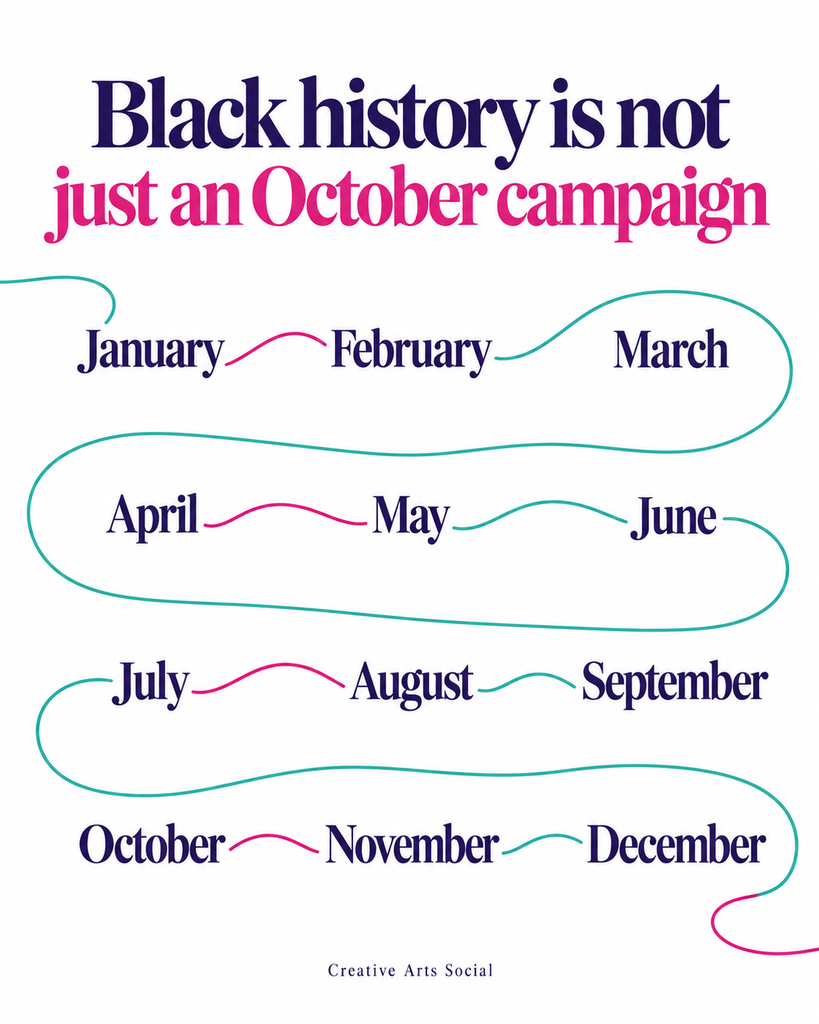
Black History Month matters. It creates space for learning, reflection, celebration and the telling of histories that institutions have too often excluded, simplified or treated as optional. But it was never meant to carry the weight of a full year’s responsibility. If your organisation celebrates Black history in October, what responsibility does it take for the histories it teaches, funds and shares throughout the rest of the year?
For Creative Arts Social, the question is not whether organisations should mark Black History Month. They should. The question is what happens in every other month: in planning meetings and collections policies; in commissioning briefs, learning programmes and audience strategies; in the everyday choices through which institutions decide what knowledge is visible, valued, funded and passed on.
That question needs more than a rhetorical answer. The Historical Association’s 2021 survey of secondary history teaching in England found that schools’ reported teaching of Black and Asian British history was strongly weighted towards the twentieth century: 127 references, compared with 12 for Roman Britain, two for the Anglo-Saxon period and one for the seventeenth century. It is only one snapshot, but it shows how easily history can become narrow in period and frame.
That narrow frame is difficult to sustain when set against the historical record. Professor Hakim Adi’s African and Caribbean People in Britain: A History (2022) traces African presence in Britain back at least to the Roman period, around two thousand years ago, and follows the lives, work and struggles of African and Caribbean people through the centuries. Black presence in Britain did not begin with Windrush in 1948. Recognising that longer history changes the starting point for what institutions teach, collect and interpret.
This is more than a question of representation. It is a question of infrastructure. Curricula, collections and public programmes are never neutral inventories of facts; they are shaped by choices about what counts as significant, whose work is treated as authoritative and which histories are considered central. When Black history is contained within a themed month, it risks producing a form of exceptionalism: celebration without context, or a small roster of individual achievements without the histories of empire, colonialism, migration, resistance, organising, creativity and community that make those achievements intelligible.
The responsibility also sits with the systems that prepare and support teachers. England’s history curriculum leaves schools considerable discretion over the examples they teach; space to include Black British history does not ensure it is taught consistently. In the Petitions Committee’s 2021 survey, one in four teachers who responded said they lacked confidence in developing pupils’ understanding of Black history and cultural diversity.
Specialised professional development or in-school training was requested by 88% of primary and 85% of secondary teachers. These findings describe the survey’s respondents, rather than every teacher, but they point to the need for sustained training, time and resources. That support should extend across subjects, including geography, art, science, English and maths, so that Black knowledge and contributions can inform everyday learning.
The term needs careful use in a UK context, but Jodi Robinson’s essay on Black History Month and Black exceptionalism offers a useful provocation. Writing about the US, she argues that repeatedly foregrounding a few “exceptional” figures can make recognition appear conditional on individual achievement. The point is not to diminish those people; it is to ask what happens when structural histories, collective action and ordinary Black lives are absent from the frame.
The consequences are cultural, emotional and organisational. The labour of education, commemoration and correction can fall, briefly and predictably, on Black staff, artists and communities, often through last-minute requests and without sustained resource or influence. A UK example sits in the Greater London Authority’s (GLA) independent review, which identified emotional labour as a burden that can impede Black, Asian and ethnic minority staff’s progression, work that white colleagues are not routinely asked to carry. The GLA is not the cultural sector, but the finding is a useful warning against treating racial equity work as an extra responsibility for those most affected by inequality.
Historian David Olusoga has consistently challenged the idea that Black history is a specialist subject. Black British history is not an addition to the national story; it is part of the national story. It reaches far beyond the post-war migration narratives that many people first encounter at school, connecting Britain to Africa, the Caribbean and the wider world across centuries. That perspective asks institutions not simply to add more names, but to reconsider the frame through which national history is understood.
Akala brings the effects on children into focus in Natives: Race and Class in the Ruins of Empire (2018). Reflecting on racism in his schooling, he describes his experiences as “not as isolated incidents with a few bad apples but rather as systemic problems”, quoted from page 245 in Dominic Davies’s essay, “Natives: Autobiography and Anti-Racism After Empire”. His account asks us to connect what happens in a classroom with the wider history that shapes it. For institutions, that means considering both what children are taught and what they learn about themselves, each other and belonging through the histories that are omitted.
Education is where the stakes are especially clear. The Runnymede Trust’s research on race and racism in English secondary schools argues that anti-racism cannot be left to occasional discussion or to individual teachers acting alone. The Black Curriculum’s call to teach Black history 365 days a year is therefore not a request for a separate, supplementary version of history, but for a fuller account of Britain that recognises Black presence, knowledge, contribution and resistance as integral rather than occasional.
Wales offers a useful policy-and-practice case study. Its Curriculum for Wales made the study of diverse Welsh history, including Black, Asian and Minority Ethnic histories, explicit and compulsory. Yet Estyn’s 2022 state-of-the-nation review found that most pupils still had limited knowledge of these histories, that very few schools audited and mapped their provision, and that teachers often lacked training and resources. The lesson is that statutory change needs curriculum planning, professional learning, time and accountability to become embedded in everyday practice.
Earlier this year, Sam attended The Black Curriculum Conference. That experience is a useful reminder that this work is sustained through conversation, scholarship and practice. It requires us to stay curious about the knowledge we have inherited, notice whose perspectives are absent and build relationships that are sustained throughout the year. In this sense, Black History Month can be a catalyst, but it cannot be the container for the work.
For cultural organisations, the test is the consistency of the choices made all year round. Whose work is collected, commissioned, programmed and credited? Whose histories shape interpretation and learning materials? Who is invited to set priorities, and who is only asked to respond to them? What do budgets, partnerships and decision-making structures reveal about an organisation’s commitments? Asking these questions moves us towards accountability and embedding change in practice.
This work is already being carried forward by organisations including The Black Curriculum, Black Cultural Archives, Museum X, Museum of Colour, The Mixed Museum and Culture&. Cultural institutions should be asking how they can learn from, resource and build sustained relationships with this work throughout the year.
Black History Month can be a powerful moment to ask these questions. But it cannot be the only moment. The task is not to make October bigger. It is to make the other eleven months, and every day within them, more honest, more informed and more accountable.
References
- Adi, H. (2022). African and Caribbean People in Britain: A History. Penguin.
- Akala (2018). Natives: Race and Class in the Ruins of Empire. Quoted in Davies, D. (2020), Natives: Autobiography and Anti-Racism After Empire, Postcolonial Writers Make Worlds.
- Department for Education. National curriculum in England: History programmes of study.
- Estyn (2022). Welsh and Black, Asian and Minority Ethnic history and culture: A state of the nation report.
- Greater London Authority. GLA Independent Review: Summary.
- Historical Association (2021). Survey of History in Secondary Schools in England 2021.
- Olusoga, D. Black and British: A Forgotten History. The National Lottery Heritage Fund.
- Robinson, J. Black History Month and Black Exceptionalism. Brown Political Review.
- Runnymede Trust (2020). Race and Racism in English Secondary Schools.
- The Black Curriculum. Teach Black History 365.
- UK Parliament, Petitions Committee (2021). MPs to debate petition relating to Black history and cultural diversity in the curriculum.
- Creative Arts Social. Sam at The Black Curriculum Conference. Instagram.