

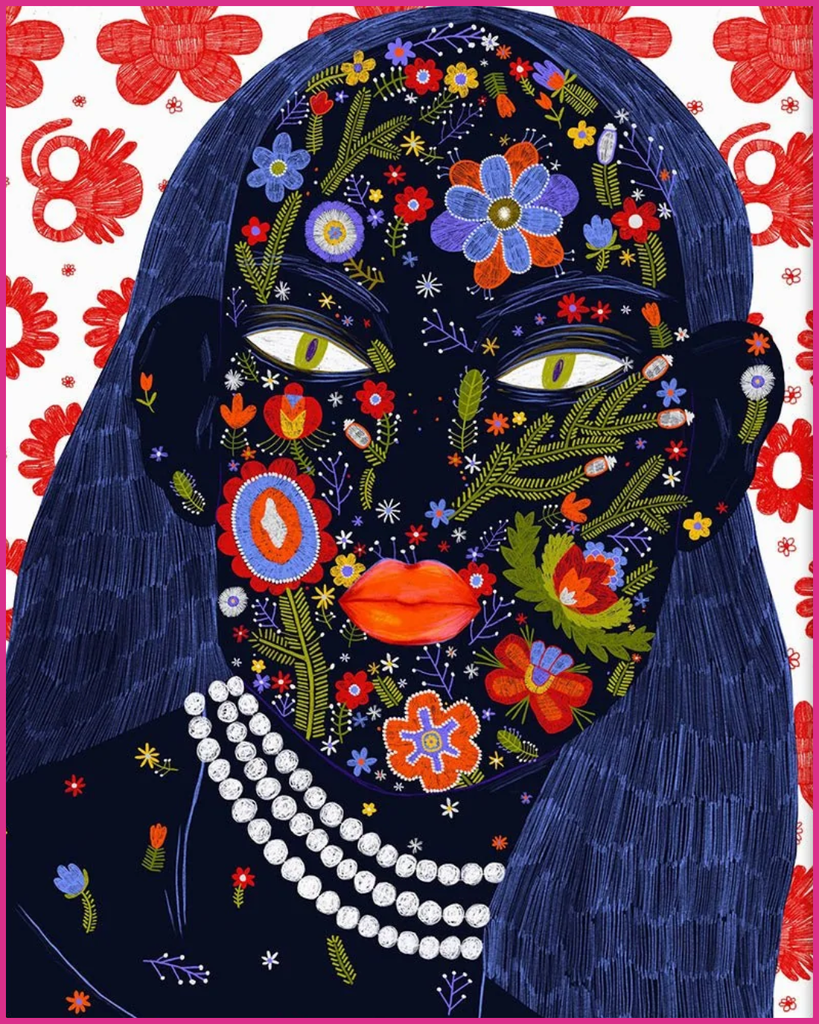
(image credit: ‘Embroidery’ by Kadna Anda)
“Difference must be not merely tolerated, but seen as a fund of necessary polarities”, Audre Lorde, “The Master’s Tools Will Never Dismantle the Master’s House”.
What does it mean to feel accepted without having to change who you are?
It is being able to contribute without editing out the parts of yourself that others consider inconvenient, unfamiliar or too much. Assimilation asks us to suppress or change parts of ourselves to fit dominant norms. In UK cultural workplaces, that pressure can appear in assumptions about which accents sound authoritative, which hairstyles look professional, or whose ways of communicating are treated as the standard. But at whose cost? For Creative Arts Social, belonging means being seen, heard, valued and understood without having to minimise, explain or change who you are. Read our fuller definition of belonging.
For Global Majority artists, colleagues and communities, acceptance can mean being valued for the fullness of your practice, rather than only when it fits an existing idea of culture, leadership or expertise shaped through a white gaze. The pressure to adapt is documented in UK research. The Fawcett Society and Runnymede Trust’s Broken Ladders report (2022) found that 61% of women of colour surveyed reported changing themselves to fit in at work, including their language, hairstyle or name. The question is what organisations lose when people feel they must leave parts of themselves at the door.
Nira Yuval-Davis, a feminist sociologist whose work examines belonging, writes that belonging is about “emotional attachment, about feeling ‘at home’”. She distinguishes this from the politics of belonging: the ways boundaries are drawn around who gets to belong, on what terms, and with what consequences. This distinction matters for cultural organisations. A space can feel warm and welcoming while still maintaining rules, often unspoken, about whose knowledge, behaviour or experience is considered legitimate and professional.
Lorde’s writing asks us to recognise difference as a source of knowledge, connection and creative possibility. Acceptance cannot mean treating everyone as though their differences do not matter. It means making room for those differences to be present without becoming a barrier to respect, opportunity or influence.
Authors and researchers john a. powell and Stephen Menendian describe belonging without othering: a form of belonging that does not require anyone else to be pushed to the margins. This is a useful test for our sector. Are we creating belonging by asking people to become more like us? Or are we changing the conditions of the organisation so that many different ways of being can be recognised?
This asks more of an organisation than inclusive language or a celebratory programme. It asks whose standards define professionalism, who those standards reward, and whose career progression they enable or obstruct. The TUC’s No worker left behind report (2026) found that 35% of Black women surveyed reported being passed over for or denied promotion. That figure concerns the wider workplace, rather than arts and culture specifically, but it sharpens the question for our sector: who is trusted to lead, and who is expected to keep adapting without progressing?
Acceptance also involves our relationship with ourselves. In her 2019 TED talk, America Ferrera reflects: “I couldn’t change what a system believed about me, while I believed what the system believed about me.” Her account makes space to question the judgements we have absorbed about our own value and possibilities. What have we learned to hide, soften or apologise for? Self-acceptance and institutional accountability belong together. Organisations remain responsible for changing the conditions that make concealment or conformity feel necessary.
Acceptance should be visible in who is trusted, who progresses, whose ideas are resourced and whose presence is understood as part of the organisation’s future.
This is a benefit for everyone, not only those most often excluded. A 2021 study by Kathryn Ostermeier, Danielle Cooper and Miguel Caldas, published in Human Performance, found that employees who perceived their organisation as a safe environment for expressing valued identities reported stronger organisational identification, job satisfaction and supportive behaviours, alongside lower burnout and intentions to leave. Conditions that allow people to be themselves can therefore strengthen connection, contribution and retention across an organisation.
For you: as a person of colour, what parts of yourself have you felt you needed to change, hide or downplay to be accepted? What would help you feel able to bring more of yourself into a cultural space?
For organisations: what parts of themselves might people still feel they need to leave outside in order to belong? What will you change in your expectations, everyday practices and progression decisions?
A further reflection: how can we bring more aspects of ourselves into our workplace, and what support would make that possible?
References:
Creative Arts Social (2026). What Belonging Means to Us.
Ferrera, A. (2019). My identity is a superpower — not an obstacle. TED2019.