

In Andrea Levy’s Small Island (2004), Hortense Joseph arrives in London from Jamaica in 1948. She brings a teaching certificate, a trunk of good clothes and complete faith that her training will speak for her. At the Education Office she is told, politely, that she cannot teach in England. Nobody says her qualifications are wrong. They simply cannot see them. Flustered, she turns to leave and walks straight into a broom cupboard.
What does it feel like to be unseen in a cultural workplace: to be there every day without quite being registered?
Our last note, Feeling Seen, opened with Ralph Ellison’s narrator, who is invisible because others refuse to see him. This note looks at the same problem from the other side, through a Black British woman’s story. Hortense is not overlooked because she hasn’t tried. She has done everything she was asked to do. Being invisible, then, is not about whether you are in the room. It is about whether the room was built to recognise what you bring into it.
What being feeling unseen feel like
In Feeling Seen we said that being seen means your presence, knowledge and perspective are treated as part of the space, not as a temporary addition. Feeling unseen is the reverse. You are tolerated, and you are useful, but you are not taken into account.
In practice it is often small and easy to deny. Your idea is ignored until a colleague says it again. Your face is on the marketing but your name is missing from the minutes. You are mistaken for the other Black or Asian woman on staff. Your expertise gets called “lived experience”, which means it is thanked rather than paid for. You are asked to front Black History Month or South Asian Heritage Month and left out of the programme for the other eleven months.
As Feeling Seen argued, this sits alongside hypervisibility. The same person can stand out as different and still go unrecognised as an authority.
Bodies out of place
The British sociologist Nirmal Puwar calls this the somatic norm. In Space Invaders (2004) she argues that institutions carry an imagined default body. Anyone who doesn’t match it is seen as “out of place”: they are noticed, but not trusted to belong. In a sector where 87% of the workforce is White (Creative PEC, 2024), that default is easy to see.
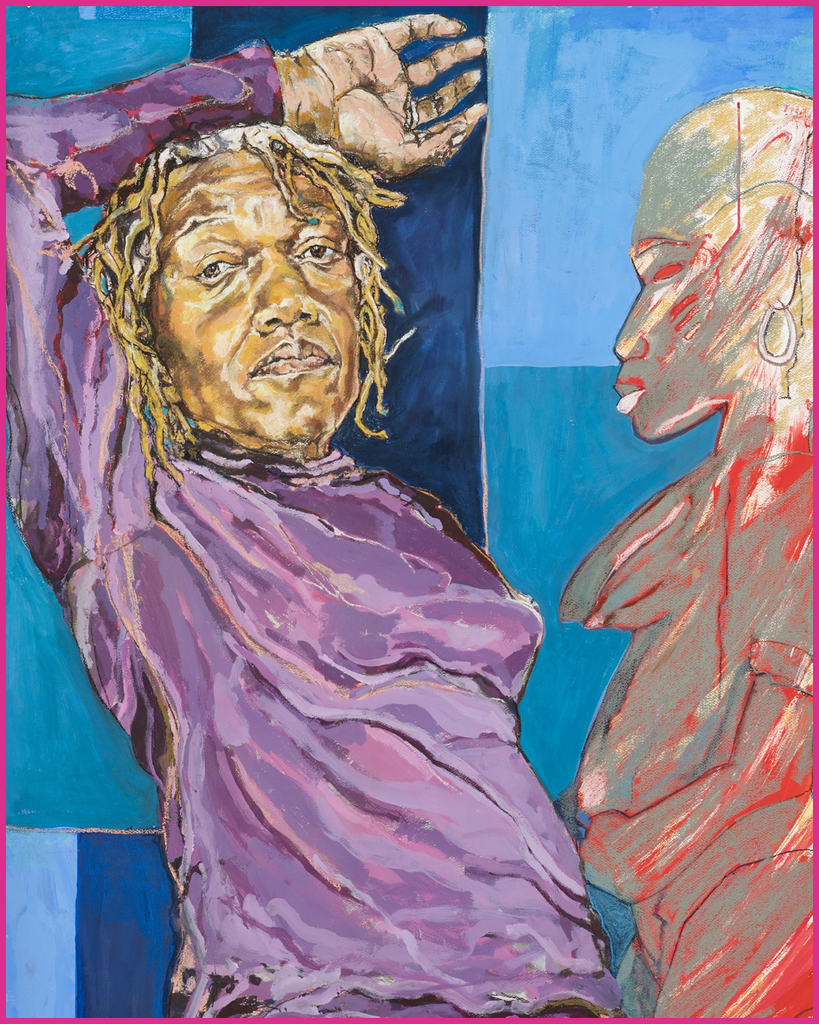
The artist Claudette Johnson has spent her career refusing that norm. As a student in the early 1980s she was the only Black student in her year, and she felt that Black women were invisible, especially in art: in Western painting they sat at the edges of the picture. Her answer was to draw Black women larger than life, so that they cannot be missed. At the First National Black Arts Conference in Wolverhampton in 1982 she questioned where Black women artists stood in the new movement, and she describes her aim as wanting “to tell a different story about our presence in this country”.
Our own definition makes the same demand. Belonging should not depend on assimilation. It means “being seen, heard, acknowledged and understood” and being able to turn up as you are. Johnson’s figures take up space without shrinking to fit, and people at work should not have to shrink either.
The cost of naming it
Audre Lorde, the Black feminist poet and essayist, warned that “your silence will not protect you” (“The Transformation of Silence into Language and Action”, in Sister Outsider, 1984). Speaking up carries its own risk, though. If you name your invisibility, you can become visible in the wrong way, as the difficult one or the complainer. Many people stay quiet instead, and their silence makes them even less visible.
This is why invisibility can’t be left to individuals to fix by speaking up more, dressing differently or working harder. Hortense did all of that.
What organisations can do
We understand belonging as something that is actively created, both a feeling and a practice. Invisibility is created too: through who gets credited, whose qualifications count, who appears in the minutes and whose ideas gain authority only when someone else repeats them. So:
- Check credit lines, meeting minutes and authorship, not just publicity images.
- Pay for knowledge, including knowledge that comes from lived experience.
- Notice when an idea is only taken up once someone else repeats it, and give credit to the person who said it first.
- Don’t make heritage months the only route to visibility.
- Co-design with people rather than designing for them, so the room is built with them in mind from the start.
Questions to sit with
For you: Where at work do you feel present but not registered? What do you do to be seen, and what does it cost you?
For organisations: Whose names, ideas and qualifications do your systems recognise automatically, and whose have to be argued for?
And finally: Hortense walked into a cupboard because the door she needed wasn’t where she expected it to be. Who decides where the doors are?
References
Creative Arts Social (2026) Belonging Notes: Feeling Seen.
Creative Arts Social (2026) What Belonging Means to Us. Available at: https://creativeartsocial.org/what-belonging-means-to-us/
Ellison, R. (1952) Invisible Man. New York: Random House.
Gayford, M. (2023) ‘Embarrassing bodies’, The Spectator, 7 October. Available at: https://www.spectator.com.au/2023/10/embarrassing-bodies/
Johnson, C. ‘Giving Space to the Presence of a Black Woman’, Tate. Available at: https://www.tate.org.uk/art/artists/claudette-johnson-mbe-15861/giving-space-presence-black-woman
Levy, A. (2004) Small Island. London: Headline.
Lorde, A. (1984) ‘The Transformation of Silence into Language and Action’, in Sister Outsider: Essays and Speeches. Trumansburg, NY: Crossing Press.
McAndrew, S., O’Brien, D., Taylor, M. and Wang, R. (2024) Arts, Culture and Heritage: Audiences and Workforce. State of the Nations series. Creative Industries Policy and Evidence Centre (Creative PEC). Available at: https://pec.ac.uk/state_of_the_nation/arts-cultural-heritage-audiences-and-workforce/
Puwar, N. (2004) Space Invaders: Race, Gender and Bodies Out of Place. Oxford: Berg.
The Courtauld (2023) ‘Claudette Johnson: Presence opens at The Courtauld Gallery’. Available at: https://courtauld.ac.uk/news-blogs/2023/claudette-johnson-presence-opens-at-the-courtauld-gallery/