

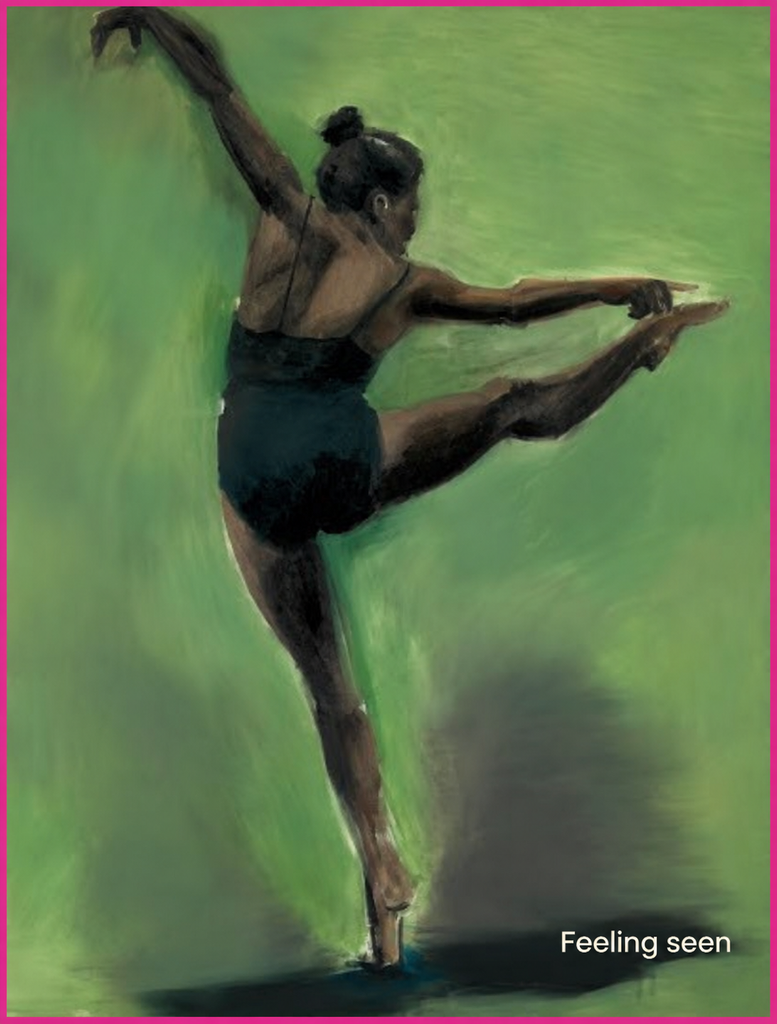
“I am invisible, understand, simply because people refuse to see me.” Ralph Ellison, Invisible Man.
What does it mean to feel seen in a cultural space?
This is the next note in Creative Arts Social’s Belonging Notes series. In “Acceptance”, we asked what it means to be welcomed without having to change who you are. Here we ask: once you are in the room, are you recognised for who you are and what you bring? Ralph Ellison (1913–1994) was an African American writer and critic. His only novel, Invisible Man (1952), follows an unnamed Black narrator whom others overlook because they see only their own assumptions about him. It won the US National Book Award in 1953.
Feeling seen is not simply about being noticed. It is about knowing that your presence, knowledge and perspective are understood as part of the space, not as a temporary addition to it. For Creative Arts Social, belonging means being seen, heard, valued and understood without having to minimise, explain or change who you are. Read our fuller definition of belonging.
It is there in the stories an organisation tells, the images it circulates, the people trusted to make decisions and the knowledge treated as valuable. It is the difference between being invited into a room and being recognised as someone who can help shape what happens there.
But visibility can be complicated. Someone can be highly visible and still not be recognised: asked to represent an experience, expected to speak for a whole community, yet excluded from the decisions that determine the programme, the collection or the strategy. Equally, people can be absent from public-facing images while the norms of an organisation continue to treat their histories and perspectives as peripheral.
The Jamaican-born cultural theorist Stuart Hall’s work on representation helps us understand why this matters. Representation does not simply reflect the world as it is; it plays a part in producing meaning. What cultural organisations choose to collect, label, commission, interpret and leave out shapes who is imagined as an artist, an authority, an audience member or a future leader. In “Whose Heritage?”, his 1999 keynote to an Arts Council of England conference, Hall asked who British heritage is for and called for diasporic histories to be part of the national story.
There is a material context too. The Creative PEC’s 2024 analysis of Census data found that 87% of people working in arts, culture and heritage occupations in England and Wales were White, compared with 84% across other occupations. It also found Black and Asian people underrepresented in the sector relative to other occupations. Data cannot tell us how an individual feels in a room, but it can show why feeling seen cannot be reduced to visibility in a campaign.
Writing about women scholars of colour in predominantly White institutions, Monika Barthwal-Datta explores the relationship between visibility, invisibility, speaking and silence. Her work prompts an important question for our sector: what does it cost to be seen only through someone else’s expectation of difference?
Research by Katrina Bell McDonald and Adia Harvey Wingfield similarly reminds us that institutional culture can make minoritised people simultaneously visible and invisible: noticeable as “different”, but overlooked as colleagues, experts and decision-makers.
The sociologist Rosabeth Moss Kanter described tokenism in Men and Women of the Corporation (1977): being one of very few brings heightened visibility, performance pressure and isolation. Her study focused on women, but many Global Majority cultural workers will recognise the pattern.
In cultural workplaces, it can mean being the only Global Majority person on a team, asked to front Black History Month or appear in the annual report, while your ideas for the main programme go unheard. It can mean being thanked for your lived experience, then left out of the decisions it was meant to inform. In each case, someone is being looked at without being seen.
For cultural organisations, being seen must mean more than appearing in a programme, campaign or consultation. It should be reflected in whose work is commissioned and collected; whose knowledge shapes interpretation; who receives credit; and who has the authority to change the frame.
In practice, that means paying people for the knowledge they share, crediting contributors by name, and checking whose names appear in decision-making minutes as well as in marketing images. It is also a question of who stays: organisations that want to interest, engage and retain Global Majority talent need to ask whether people are being featured or being heard.
For you: When have you felt truly seen in a cultural space, and what made the difference? Have you ever been visible but not heard?
For organisations: Whose faces do you feature, and whose judgement do you act on? What would change if the people in your publicity also shaped your programmes, budgets and hiring?
A question to take with you: Who is visible in your organisation, and who has the power to decide what visibility means?
References:
- Barthwal-Datta, M. (2023). “On In/Visibility.”
- Creative Arts Social (2026). What Belonging Means to Us.
- Creative PEC (2024). UK Arts, Culture and Heritage Audiences + Workforce.
- Ellison, R. (1952). Invisible Man. Random House.
- Hall, S., Evans, J. and Nixon, S. (eds.) (2024). Representation: Cultural Representations and Signifying Practices.
- Hall, S. (1999). “Whose Heritage? Un-settling ‘The Heritage’, Re-imagining the Post-nation.” Third Text, 13(49), 3–13.
- Kanter, R. M. (1977). Men and Women of the Corporation. Basic Books.
- McDonald, K. B. and Wingfield, A. M. H. (2009). “(IN)VISIBILITY BLUES: The Paradox of Institutional Racism.”