

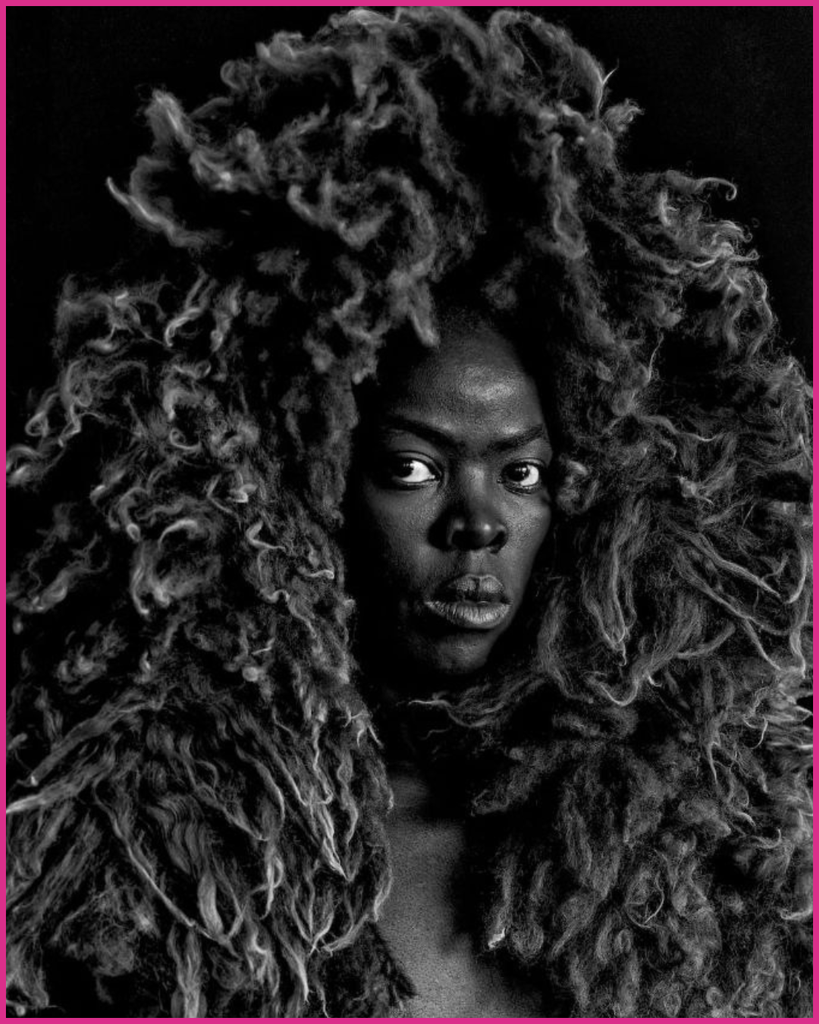
(image credit: Zanele Muholi)
What does conformity ask of us in cultural spaces?
This is the next note in Creative Arts Social’s Belonging Notes series. In “Acceptance”, we asked what it takes to be welcomed without having to make ourselves smaller. Conformity turns it on its head: what happens when the standards of a cultural space quietly ask some people to adapt more than others?
For CAS, belonging is actively created. It means being seen, heard, acknowledged and understood; being able to contribute, question and flourish without having to minimise, continually explain or change who you are. It is not an invitation to fit existing norms at the expense of yourself.
Conformity is often presented as professionalism, “good fit” or simply “how we do things here”. But in cultural spaces, those phrases can mask a quieter pressure: to adopt a particular accent, way of speaking, style of dress, network, artistic reference point or way of disagreeing in order to be taken seriously. For Global Majority cultural workers and artists, “professional” can be read through a white gaze, with confidence, neutrality or polish defined against a narrow set of norms. The pressure can be to shrink, speak more quietly and adopt a work persona that feels psychologically unsafe and exhausting to maintain in order to fit white organisational culture. Tema Okun’s revised and updated work on White Supremacy Culture offers a lens for examining how institutional habits become normalised.
The evidence makes the gap between openness and access hard to ignore. King’s College London’s Creative Majority report found that only 16% of the creative workforce came from working-class social origins, compared with just under one-third across the UK economy. It also reports that men from privileged backgrounds are five times more likely to work in a creative occupation than working-class women. These patterns sit alongside the experiences behind the statistics: unequal access to unpaid opportunities, informal networks and the cultural confidence that institutions too easily mistake for merit.
Kenji Yoshino is an American legal scholar and the author of Covering: The Hidden Assault on Our Civil Rights. He uses “covering” to describe pressure “to tone down a disfavored identity” in order to fit the mainstream. His work emerges from a US legal context, but it gives us useful language for a familiar dynamic: people may be welcomed, yet only on the condition that difference becomes less visible. That is assimilation, not belonging.
The French sociologist Pierre Bourdieu helps us see that this is not only about individual taste. Across his work on education, class, social reproduction and cultural capital, he examined how social advantages come to feel natural. His writing on taste reminds us that what is regarded as refined, appropriate or high quality is never entirely neutral. In arts and culture, that should prompt us to ask who gets to define good taste, professional conduct and artistic merit, and whose ways of being are dismissed before they are properly understood. UK-based sociologist Nirmal Puwar extends this discussion in Space Invaders: Race, Gender and Bodies Out of Place (2004), examining how institutions treat some bodies as naturally belonging and mark others as out of place.
Orian Brook, Dave O’Brien and Mark Taylor’s research on the UK’s cultural and creative industries shows how race, class and gender shape who gets into cultural work, who gets on and whose precarity is treated as an acceptable cost of entry. They challenge the comforting idea that talent alone determines access or progression. Their work shows that unpaid labour, family resources, geography, social networks and early access to culture can all shape opportunity, and that these pressures are not experienced equally. Informal networking can create further barriers: when relationship-building is organised around going for drinks, some Muslim colleagues who avoid alcohol-centred settings may be excluded from opportunities where relationships are strengthened and professional networks grow.
There are practical examples of organisations opening their practices to scrutiny. In a published Historic England case study, the Council for British Archaeology did not begin by simply recruiting more diverse trustees. It changed the conditions of participation: shorter and differently timed meetings, hybrid attendance, clearer board papers, trustee support plans and equity built into governance discussions. The case is not a universal model, but it offers a useful principle: representation becomes more meaningful when the rules, rhythms and expectations of the organisation change too.
Conformity asks us to look beyond whether an organisation’s values sound inclusive and examine how its expectations of professionalism, “fit” and participation shape who can thrive. If institutions want to interest, engage and retain Global Majority talent, they need to question the norms that demand some people adapt more than others. A culture of belonging makes room for challenge, difference and dissent; it does not require sameness.
A question to take with you: what unspoken rules does your organisation reward, who has to work hardest to meet them, and who benefits from them?
References:
Bourdieu, P. (1984). Distinction: A Social Critique of the Judgement of Taste.
Creative Majority. (2021). King’s College London.
Historic England. (2024). Case Study: Changing Board Practices to Be Inclusive and Welcoming to All.
Yoshino, K. (2006). Covering: The Hidden Assault on Our Civil Rights.
Okun, T. (2021, updated 2025). White Supremacy Culture. https://www.whitesupremacyculture.info/
Puwar, N. (2004). Space Invaders: Race, Gender and Bodies Out of Place. Berg. https://www.gold.ac.uk/sociology/staff/puwar/